Research Peptide Blog Database
Peer-reviewed studies, clinical data, mechanism breakdowns, and molecular specifications — all in one place.
Copper Tripeptide-1
GHK-Cu
A naturally occurring copper tripeptide investigated in peer-reviewed research for tissue remodeling, collagen synthesis, and epigenetic gene modulation. For in vitro research use only.
What Research Has Shown
Summary of key metrics from published clinical and preclinical literature. For educational reference only.
* All data sourced from peer-reviewed literature. For educational reference only.
Published Scientific Research
Peer-reviewed studies investigating GHK-Cu sourced from PubMed-indexed journals for educational reference only.
GHK Peptide as a Natural Modulator of Multiple Cellular Pathways in Skin Regeneration.
GHK (glycyl-L-histidyl-L-lysine) is present in human plasma, saliva, and urine but declines with age. It is proposed that GHK functions as a complex with copper 2+ which accelerates wound healing and skin repair. GHK stimulates...
View Full Study on PubMed →The human tri-peptide GHK and tissue remodeling.
Tissue remodeling follows the initial phase of wound healing and stops inflammatory and scar-forming processes, then restores the normal tissue morphology. The human peptide Gly-(L-His)-(L-Lys) or GHK, has a copper 2+ (Cu(2+)) affinity similar to...
View Full Study on PubMed →An injectable hydroxyapatite microsphere filler loaded with GHK-Cu tripeptide for anti-Inflammatory and antioxidant.
With the wide application of soft tissue fillers, implant material-induced inflammatory reactions have become a key factor affecting the therapeutic efficacy. This study developed an injectable filler with enhanced anti-inflammatory and antioxidant effects by adsorbing...
View Full Study on PubMed →Stimulation of collagen synthesis in fibroblast cultures by the tripeptide-copper complex glycyl-L-histidyl-L-lysine-Cu2+.
Glycyl-L-histidyl-L-lysine (GHK) is a tripeptide with affinity for copper(II) ions and was isolated from human plasma. This peptide appears to play a physiological role in wound healing. We report the stimulating effect of GHK-Cu on...
View Full Study on PubMed →Protective effects of GHK-Cu in bleomycin-induced pulmonary fibrosis via anti-oxidative stress and anti-inflammation pathways.
Idiopathic pulmonary fibrosis (IPF) is a serious lung problem with advancing and diffusive pulmonary fibrosis as the pathologic basis, and with oxidative stress and inflammation as the key pathogenesis. Glycyl-L-histidyl-l-lysine (GHK) is a tripeptide participating...
View Full Study on PubMed →Stem cell recovering effect of copper-free GHK in skin.
The peptide Gly-His-Lys (GHK) is a naturally occurring copper(II)-chelating motifs in human serum and cerebrospinal fluid. In industry, GHK (with or without copper) is used to make hair and skin care products. Copper-GHK plays a...
View Full Study on PubMed →Biotinylated GHK peptide incorporated collagenous matrix: A novel biomaterial for dermal wound healing in rats.
Matrikines are small peptide fragments of extracellular matrix proteins that display potent tissue repair activities. Difficulties in achieving sustained delivery of bioactive concentration of matrikines in the affected area limits their therapeutic use. The present...
View Full Study on PubMed →Biomimetic Hydrogel Scaffolds with Copper Peptide-Functionalized RADA16 Nanofiber Improve Wound Healing in Diabetes.
Wound healing in diabetes is retarded by the dysfunctional local microenvironment. Although there are many studies using hydrogels as substitutes for natural extracellular matrices (ECMs), hydrogels that can mimic both the structure and functions of...
View Full Study on PubMed →Technical Specifications
🔬 Molecular Profile
🧊 Storage Requirements
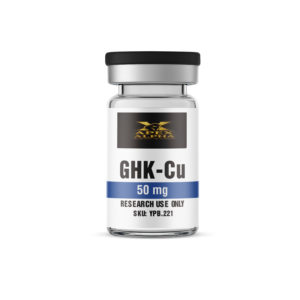
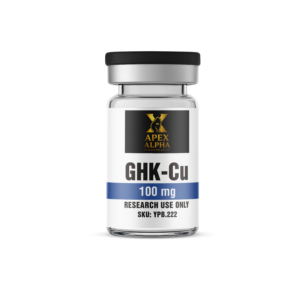
Research-Grade GHK-Cu
≥98% purity, third-party COA verified, lyophilized for stability. For in vitro laboratory research use only.
⚠️ Important Research Notice
All compounds listed are intended exclusively for in vitro laboratory research by qualified professionals. Not for human or animal consumption. Not approved by the FDA for any diagnostic, therapeutic, or clinical purpose. All research findings are sourced from peer-reviewed journals for educational reference only. Not to be interpreted as medical advice or product claims.