
Research Peptide Blog Database
Peer-reviewed studies, clinical data, mechanism breakdowns, and molecular specifications — all in one place.
Synthetic GH Secretagogue · Hexapeptide
Hexarelin
GH secretagogue. For in vitro research use only.
Published Scientific Research
Peer-reviewed studies investigating Hexarelin sourced from PubMed-indexed journals for educational reference only.
The Growth Hormone Secretagogue Hexarelin Protects Rat Cardiomyocytes From in vivo Ischemia/Reperfusion Injury Through Interleukin-1 Signaling Pathway.
Hexarelin, a synthetic growth hormone-releasing peptide, has been proven to possess cardioprotective actions through its binding to the growth hormone secretagogue receptor (GHSR) 1a and the non-GHSR receptor CD36. However, its effect on myocardial ischemia/reperfusion...
View Full Study on PubMed →The cardiovascular action of hexarelin.
Hexarelin, a synthetic growth hormone-releasing peptide, can bind to and activate the growth hormone secretagogue receptor (GHSR) in the brain similar to its natural analog ghrelin. However, the peripheral distribution of GHSR in the heart...
View Full Study on PubMed →The growth hormone secretagogue hexarelin improves cardiac function in rats after experimental myocardial infarction.
Several studies have shown that GH can enhance cardiac performance in rats after experimental myocardial infarction and in humans with congestive heart failure. In the present study, the hemodynamic effects of hexarelin (Hex), an analog...
View Full Study on PubMed →Hexarelin, a growth hormone secretagogue, protects the isolated rat heart from ventricular dysfunction produced by exposure to calcium-free medium.
The effect of hexarelin, a potent synthetic growth hormone (GH)-secretagogue, and of human GH were studied on the mechanical and metabolic changes elicited by the calcium-paradox phenomenon in isolated rat hearts submitted to 5 min...
View Full Study on PubMed →Growth hormone secretagogue binding sites in peripheral human tissues.
The family of GH secretagogues (GHS) includes peptidyl (hexarelin) and nonpeptidyl (MK 0677) molecules possessing specific receptors in the brain, pituitary, and thyroid. GHS receptor subtypes have also been identified in the heart; and a...
View Full Study on PubMed →Implications of ghrelin and hexarelin in diabetes and diabetes-associated heart diseases.
Ghrelin and its synthetic analog hexarelin are specific ligands of growth hormone secretagogue (GHS) receptor. GHS have strong growth hormone-releasing effect and other neuroendocrine activities such as stimulatory effects on prolactin and adrenocorticotropic hormone secretion....
View Full Study on PubMed →Hexarelin suppresses cardiac fibroblast proliferation and collagen synthesis in rat.
Abnormal growth of cardiac fibroblasts is critically involved in the pathophysiology of cardiac hypertrophy/remodeling. Hexarelin is a synthetic growth hormone secretagogue (GHS), which possesses a variety of cardiovascular protective activities mediated via the GHS receptor...
View Full Study on PubMed →One dose of oral hexarelin protects chronic cardiac function after myocardial infarction.
Both hexarelin and its natural analog ghrelin exert comparable cardioprotective activities. A single dose of ghrelin administered at the very acute phase after experimental myocardial infarction positively affects cardiac function in chronic heart failure. Therefore,...
View Full Study on PubMed →Technical Specifications
🔬 Molecular Profile
🧊 Storage Requirements
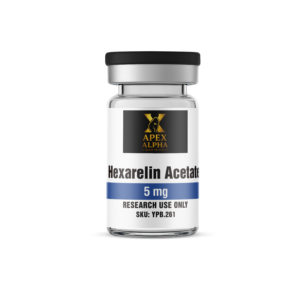
Research-Grade Hexarelin
≥98% purity, third-party COA verified, lyophilized for stability. For in vitro laboratory research use only.
⚠️ Important Research Notice
All compounds listed are intended exclusively for in vitro laboratory research by qualified professionals. Not for human or animal consumption. Not approved by the FDA for any diagnostic, therapeutic, or clinical purpose. All research findings are sourced from peer-reviewed journals for educational reference only. Not to be interpreted as medical advice or product claims.