Research Peptide Blog Database
Peer-reviewed studies, clinical data, mechanism breakdowns, and molecular specifications — all in one place.
Selective GH Secretagogue · Ghrelin Receptor Agonist
Ipamorelin
GH secretagogue. For in vitro research use only.
Published Scientific Research
Peer-reviewed studies investigating Ipamorelin sourced from PubMed-indexed journals for educational reference only.
The growth hormone secretagogue receptor 1a agonists, anamorelin and ipamorelin, inhibit cisplatin-induced weight loss in ferrets: Anamorelin also exhibits anti-emetic effects via a central mechanism.
This study investigated whether ghrelin mimetics, namely anamorelin and ipamorelin, can alleviate weight loss and inhibition of feeding observed during acute and delayed phases of cisplatin-induced emesis in ferrets. The potential of anamorelin to inhibit...
View Full Study on PubMed →Ipamorelin, the first selective growth hormone secretagogue.
The development and pharmacology of a new potent growth hormone (GH) secretagogue, ipamorelin, is described. Ipamorelin is a pentapeptide (Aib-His-D-2-Nal-D-Phe-Lys-NH2), which displays high GH releasing potency and efficacy in vitro and in vivo. As an...
View Full Study on PubMed →Influence of chronic treatment with the growth hormone secretagogue Ipamorelin, in young female rats: somatotroph response in vitro.
Growth hormone (GH) is secreted in the anterior pituitary gland by the somatotroph cells. Secretion is regulated by growth hormone releasing hormone (GHRH) and somatostatin. Morever, GH secretagogues (GHS) can exert a considerable effect on...
View Full Study on PubMed →The growth hormone secretagogue ipamorelin counteracts glucocorticoid-induced decrease in bone formation of adult rats.
The ability of the growth hormone secretagogue (GHS) Ipamorelin to counteract the catabolic effects of glucocorticoid (GC) on skeletal muscles and bone was investigated in vivo in an adult rat model. Groups of 8-month-old female...
View Full Study on PubMed →Peptidomimetic growth hormone secretagogue derivatives for positron emission tomography imaging of the ghrelin receptor.
The ghrelin receptor is a seven-transmembrane (7-TM) receptor known to have an increased level of expression in human carcinoma and heart failure. Recent work has focused on the synthesis of positron emission tomography (PET) probes...
View Full Study on PubMed →Growth hormone and growth hormone secretagogue effects on nitrogen balance and urea synthesis in steroid treated rats.
Growth hormone (GH) reduces the catabolic side effects of steroid treatment via effects on the amino-nitrogen metabolism. Ipamorelin is a synthetic peptide with GH releasing properties. We wished to study the metabolic effects of Ipamorelin...
View Full Study on PubMed →Methylprednisolone does not inhibit the release of growth hormone after intravenous injection of a novel growth hormone secretagogue in rats.
The present study was undertaken to study the growth hormone-releasing properties and growth-promoting effect of a GH secretagogue ipamorelin (IPA) in rats given the synthetic glucocorticoid methylprednisolone (MP). In a first experiment, rats received either...
View Full Study on PubMed →Do growth hormone-releasing peptides act as ghrelin secretagogues?
NN703 is an orally active and selective growth hormone secretagogue (GHS) that was derived from growth hormone-releasing peptide-1(GHRP-1) via ipamorelin by a peptidomimetic approach and has now entered into phase II clinical trials. When the...
View Full Study on PubMed →Technical Specifications
🔬 Molecular Profile
🧊 Storage Requirements
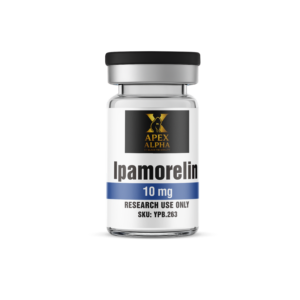
Research-Grade Ipamorelin
≥98% purity, third-party COA verified, lyophilized for stability. For in vitro laboratory research use only.
⚠️ Important Research Notice
All compounds listed are intended exclusively for in vitro laboratory research by qualified professionals. Not for human or animal consumption. Not approved by the FDA for any diagnostic, therapeutic, or clinical purpose. All research findings are sourced from peer-reviewed journals for educational reference only. Not to be interpreted as medical advice or product claims.